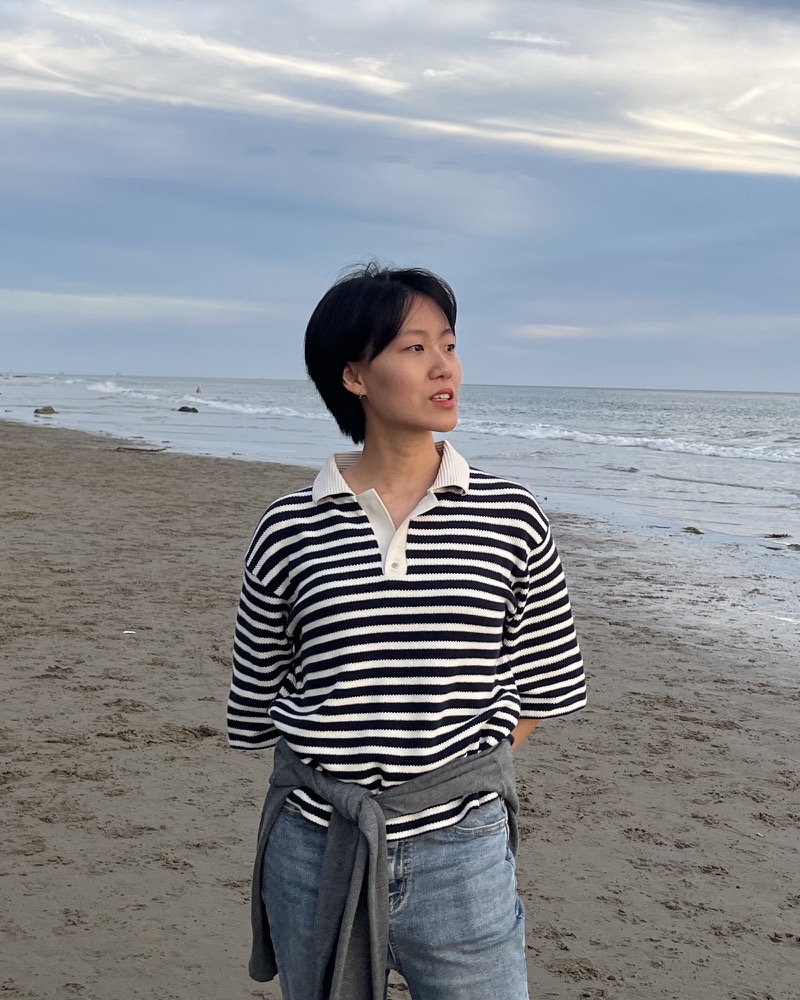
About my Website and Me
Introduction
This website is to list what I have done. Here is my CV, for more detailed informations.
Research interest
- Quantum information science and quantum computing
- Machine learning and optimization
Education
- Cornell University
- PhD candidate in physics
- Gwangju Institute of Science & Technology (GIST college website)
- B.S. Physics, minor in Math
Research Experience
2026
- 26-spring
2025
- 25-fall
2024
- 24-fall to 25-spring: Learning the phases of monitored quantum dynamics
- Developed a scalable, data-centric framework for detecting measurement-induced phase transitions (MIPTs) in monitored circuits without post-selection or classical simulation, enabling experimental observability on near-term quantum hardware
- Experimental collaboration with Quantinuum in the ongoing follow-up work.
- Manuscript under review in PRX Intelligence: H. Kim, A. Kumar, Y. Zhou, Y. Xu, R. Vasseur, E.-A. Kim, Learning measurement-induced phase transitions using attention, arXiv:2508.15895

2022
- 22-fall to 24-spring: Attention to Quantum Complexity
- Introduce Quantum Attention Network (QuAN) that leverages the power of attention mechanisms driving large language models (LLM) to characterize complexity of quantum states from bit string data.
- Resolved three open problems (i) witnessing entanglement scaling transition, (ii) detecting the growth of quantum complexity in deep random quantum circuit despite the noise, (iii) revealing mixed-state topological order of toric code.
- Collaboration with Google Quantum AI and MIT.
-
Published in Science Advances: H. Kim, Y. Zhou, Y. Xu, K. Varma, A. H. Karamlou, I. T. Rosen, J. C. Hoke, C. Wan, J. P. Zhou, W. D. Oliver, Y. D. Lensky, K. Q. Weinberger, E.-A. Kim, Attention to Quantum Complexity, Sci. Adv. 11, eadu0059 (2025).

2021
- 21-fall to 22-spring
- Interpretation on minimal neural network to learn the metal-insulator transition in the dynamical mean-field theory. Analyzing the network connectivity to find the system measure that can be employed to broader range beyond our specific setup, based on the few bath orbitals from DMFT-ED.
- Published: H. Kim, D. Kim, D.-H. Kim, Minimal Neural Network to Learn the Metal-insulator Transition in the Dynamical Mean-field Theory, NPSM 2022, 72, 487-494 (2022).
- (github, summary)


- 21-summer
- 21-spring
-
Undergraduate thesis 1: Calculating the hybridization function on DMFT-NRG, trying to improve the accuracy of the metal-insulator transition points.


-
2020
- 20-summer
-
Summer Undergraduate Research Fellowship (G-SURF): Markov-chain-MonteCarlo method and Ising model + Self-learning Monte-Carlo (github, summary_slmc, summary_ising)

.png)
.png)
-
2019
- 19-winter
- AdS-CFT with deep learning: Tensorflow (github)
Extra curriculum
2025
- 25-fall
- Teaching Assisntant for PHYS 2214 Oscillations, Waves, and Quantum Physics. Manage discussion sections, lab sections, homework, and exams.
2022
- Teaching Assisntant for PHYS 2214 Oscillations, Waves, and Quantum Physics. Manage discussion sections, lab sections, homework, and exams.
- 22-fall
- Teaching Assistant for PHYS 2213 Electromagnetism: Manage discussion sections, homework, and exams.
2021
- 21-fall
- Teaching Assistant for General Physics I in English
- Presentation in Nuclear & Particle Physics: (1) Renormalization group, (2) Neutrino Oscillation
- 21-spring
- Teaching Assistant for General Physics I
- Project on Machine learning & Deep learning: implementing neural network classifier for CIFAR100 dataset on Kaggle
2020
- 20-fall
- Presentation in Thermal & Statistical Physics: Transverse-field Ising model (summary)
- 20-spring
- Teaching Assistant for General Physics I
- Project in Quantum Physics I: Exact solution of finite harmonic oscillator (summary)
2019
- 19-summer
- Boston University summer international exchange: Introductory Microeconomic Analysis, Basic Statistics and Probability
- 19-spring
- Presentation in Physics & Math Seminar: Coanda effect (summary)
2018
- 18-winter
- Caltech collaboration course, Physical Biology of the Cell (PBoC)
2016-7
- Korean Youth Physicists’ Tournament (KYPT): Fast chain, Spiral wave, Torsion gyroscope