Cornell University · Ph.D. expected summer 2027
Hyejin Kim
Ph.D. Candidate in Physics

I develop physics-informed machine-learning methods that extract structure from limited quantum measurements and turn it into reliable decisions for quantum discovery, error correction, and hardware control.
- Learn many-body structure and dynamics directly from finite, noisy measurement records.
- Decode logical information with architectures that respect circuit geometry and causal structure.
- Compile quantum circuits into hardware-feasible control decisions under realistic constraints.
Selected work
Learning architectures for complex quantum systems
Current work · manuscript in preparation
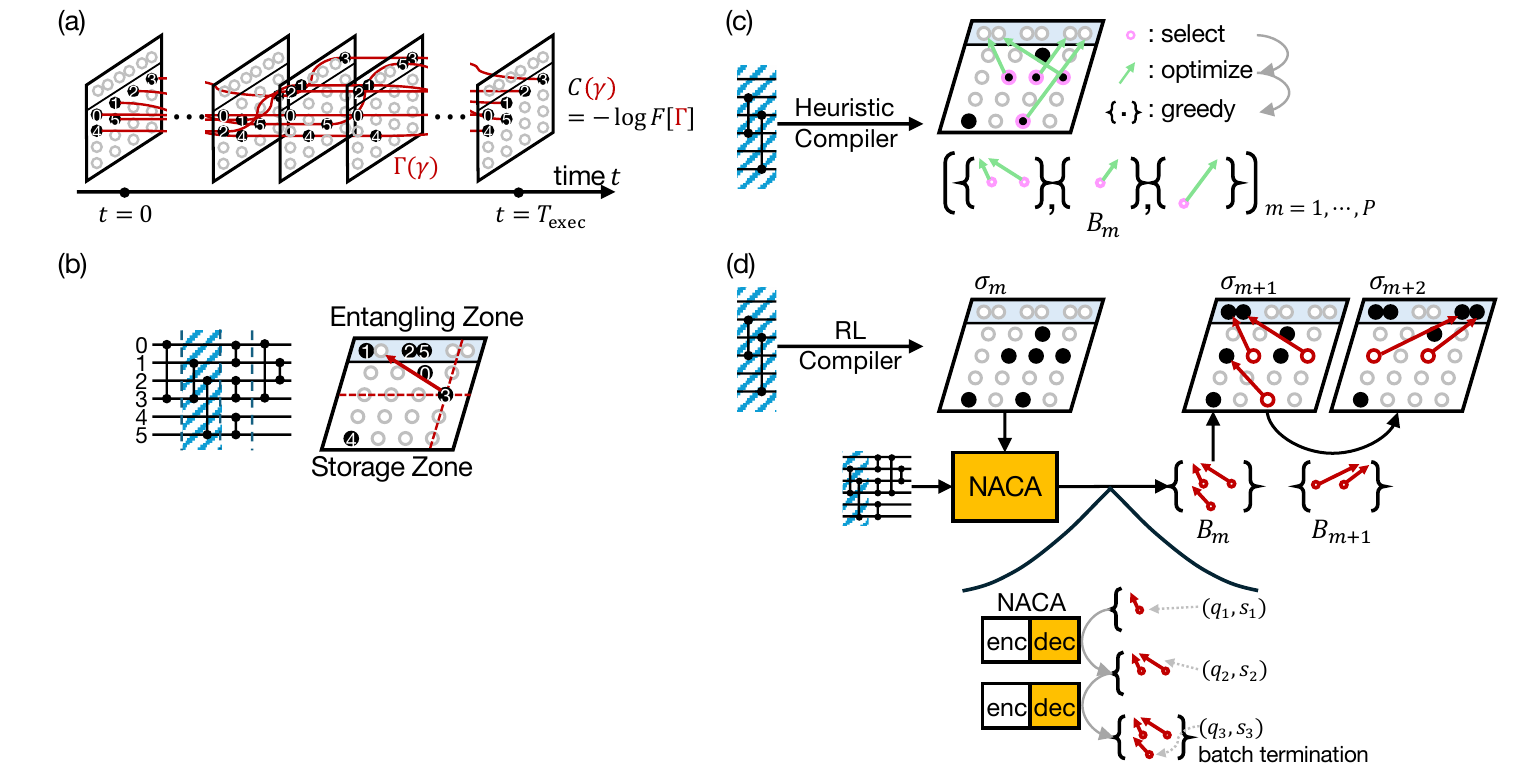
Hardware-aware neutral-atom compilation
The Neutral Atom Compiler Agent (NACA) constructs parallel atom-transport batches autoregressively while masking physically invalid actions. It jointly reasons about placement, movement, scheduling, and modeled device error.
Across the studied circuits, learned policies improve modeled fidelity over a heuristic compiler and transfer across circuit sizes and families.
Preprint · under review
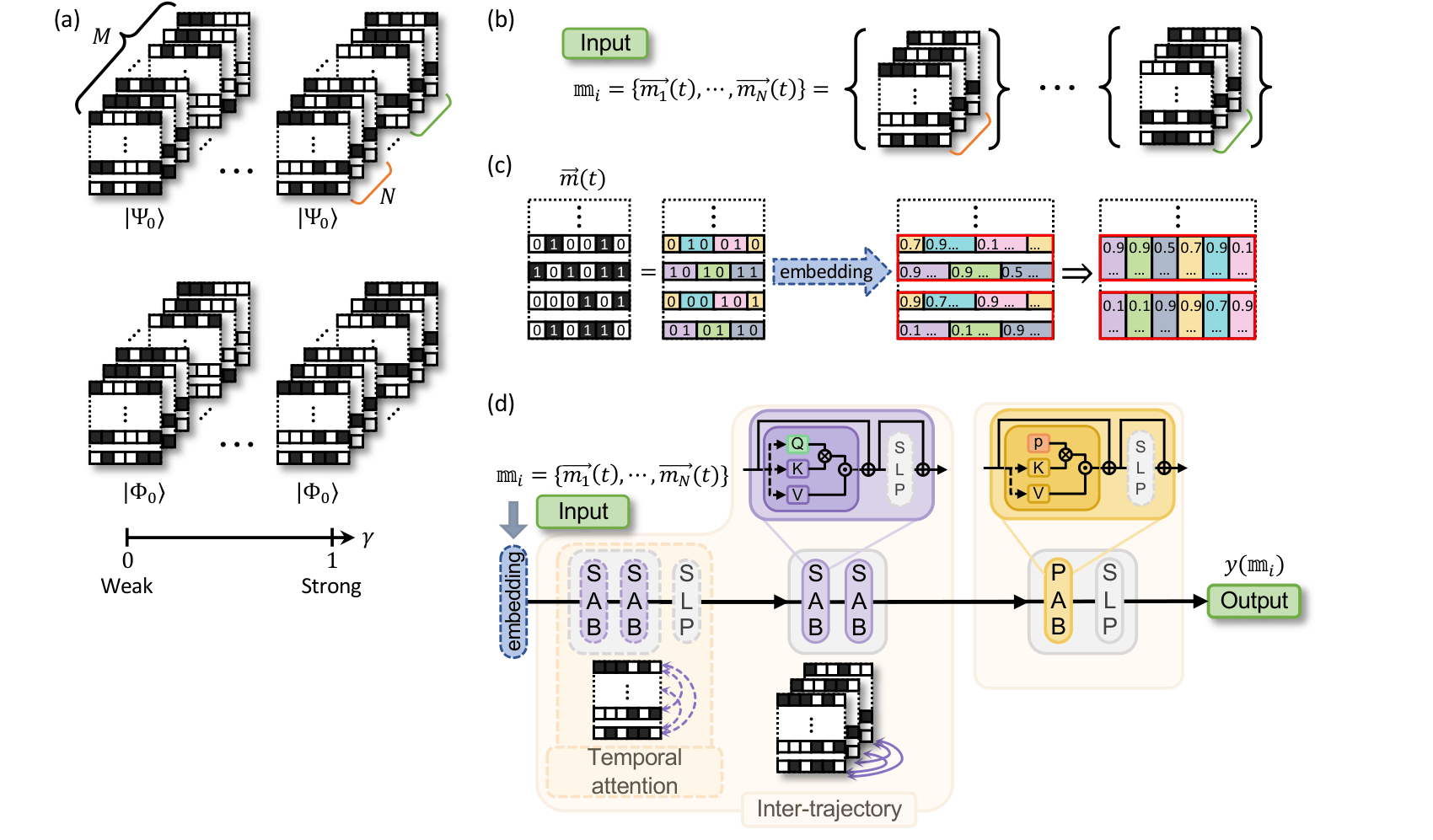
Learning monitored quantum dynamics
I extended attention across measurement trajectories and time to detect measurement-induced phase transitions without trajectory post-selection or classical simulation.
The method provides a sample-efficient, noise-tolerant route toward experiments beyond classically tractable regimes. Follow-up work with Quantinuum is ongoing.
Published · Science Advances (2025)
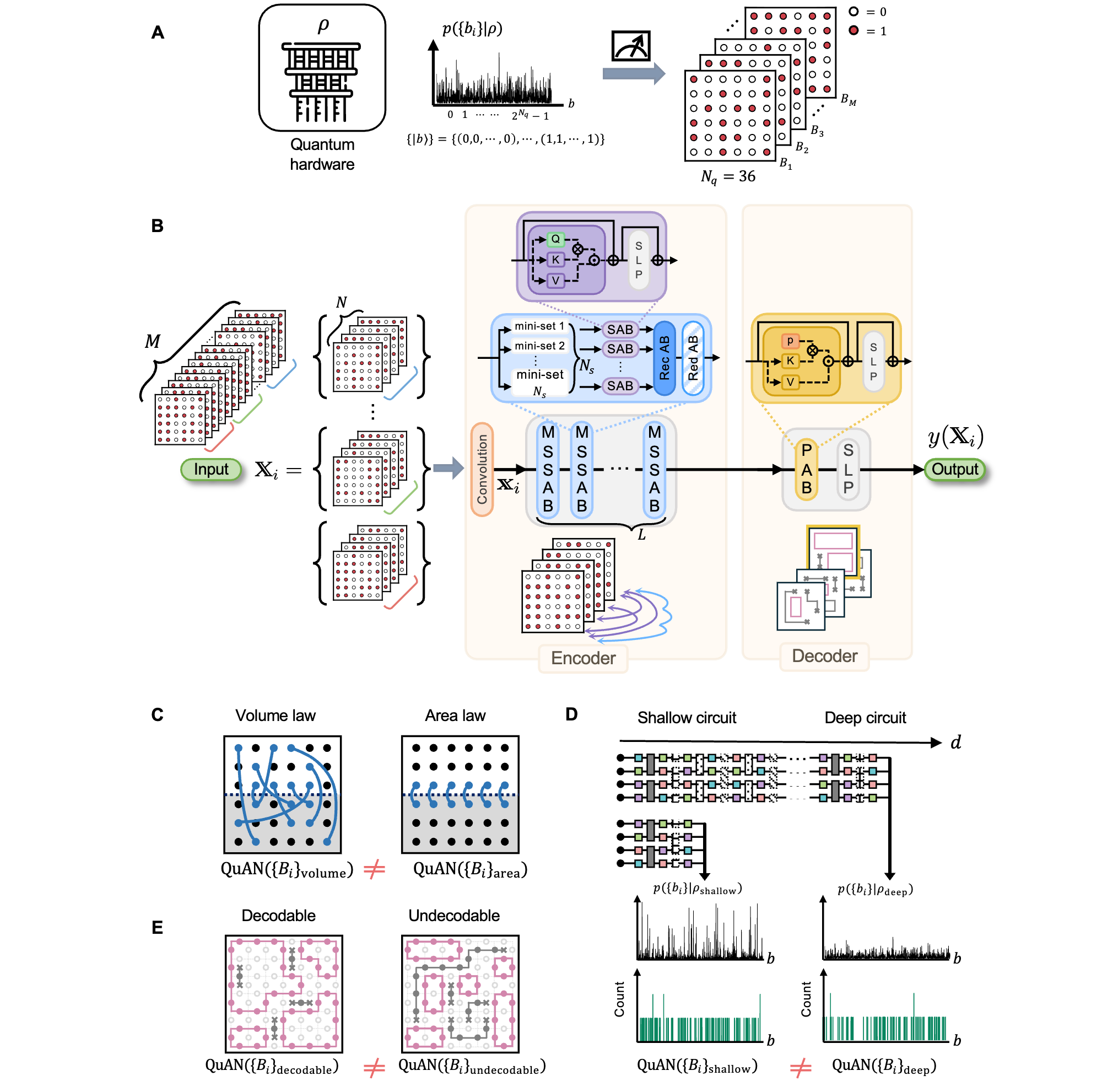
Attention to quantum complexity
I co-developed the Quantum Attention Network (QuAN), which treats quantum-measurement snapshots as an unordered set and learns distribution-level correlations without reconstructing the full quantum state.
The framework resolves entanglement-scaling transitions, detects complexity growth in noisy random circuits, and reveals mixed-state topological order.
Current direction
Scalable decoding for fault-tolerant quantum circuits
I am developing a sparse-attention circuit-level decoder for the surface code. The goal is to retain the modular structure needed for logical operations while reducing the memory and computation required as code distance grows.
Read about the projectContact